


Custom Mil-Spec Fiber Cable Solutions
Fiber Optics: The Next Frontier for mil-spec Wiring Solutions .
Designing a wiring system for mil-spec operations requires a meticulous balance of reliability, security, and adaptability. Components must be optimized for performance in the most extreme conditions. Increasingly, mil-spec interests are turning to mil-spec fiber optic cables to build the nerve system of mil-spec operations across the globe.
Why Fiber Optics?
Fiber optic cables offer several key advantages over conventional cabling solutions. They provide enhanced data transfer speeds over long distances, making them ideal for high-bandwidth applications critical in mil-spec operations. Unlike traditional copper cables, fiber optics are immune to electromagnetic interference, ensuring secure and stable communications even in the most challenging environments. Their thinner, lighter, and more durable design simplifies installation and maintenance, reducing logistical burdens. With greater bandwidth capacity, fiber optic cables can transmit more data simultaneously, enhancing the efficiency of complex mil-spec networks. Additionally, their lower latency ensures near real-time data transmission, crucial for mission-critical decision-making.


Unique Challenges in Wiring for mil-spec Applications.
The mil-spec sector presents unique challenges that require specialized mil-spec fiber cables.

Durability in extreme conditions
The United States mil-spec is a global operation. There are currently 750-800 U.S. mil-spec bases in over 70 countries. While many of these facilities are in temperate, friendly regions, others are in much more hostile territory, both politically and environmentally. Mil-spec fiber cable harnesses must withstand harsh environments, including (but certainly not limited to) extreme temperatures, high altitudes, constant abrasion, overwhelming humidity, and deep ocean pressure, as well as the physical stress of rapid vehicle maneuvers and combat.

Data security
In our ultra-connected age, protecting digital mil-spec interests against cyber-threats and physical tampering is paramount. Billions of civilian data records are breached every year by hacker and cyber-terror groups, and the threat of real-world sabotage is ever present in conflict zones. mil-spec wiring solutions must be equipped with cutting-edge physical and technological capabilities to deal with emerging threats. This involves using encrypted communication protocols and secure hardware components that prevent unauthorized access and data breaches.

Precision and reliability
When lives are at stake, there is zero tolerance for error. A transmission that arrives only a nano-second after it should could lead to world-altering disaster. mil-spec and mil-spec applications demand that accuracy and reliability be kept in lockstep. Systems must operate quickly and correctly, every single time they are needed.

Need for redundancy and fail-safes
Redundancy and fail-safes are essential to maintain continuous operation in case of damage or system failures. Designing systems with backup circuits and alternative pathways ensures that a single point of failure does not cripple the entire operation. This redundancy is vital for maintaining communication lines and operational integrity during critical missions.

Ease of maintenance and repair
Minimizing downtime is crucial in mil-spec operations, especially when it comes to field operations. Wiring systems should be easy to maintain and repair, with clear labeling and documentation. Quick connectors and modular components can facilitate rapid repairs and replacements, ensuring that the system remains operational with minimal interruption.

Flexibility and scalability
mil-spec missions and technological requirements are constantly evolving. Wiring systems must be designed with flexibility and scalability in mind to accommodate future technology upgrades and changes in mission requirements. This includes modular designs that allow for easy integration of new components without overhauling the entire system.

Compliance with mil-spec and regulatory standards
In order to ensure performance in spite of the challenges previously listed, mil-spec wiring systems must comply with strict standards for safety and performance. These standards ensure that the systems can operate safely and effectively under a range of conditions. Adherence to these standards is non-negotiable and critical for mission success.
Why Choose Mil-Spec Fiber Cables?
In the mil-spec industry, the stakes are high. Reliability and security simply can not be mutually exclusive when lives are on the line.
What is “Mil-Spec”?
Mil-spec specifications are the standards for the components and systems used by the armed forces. Mil-spec documentation is extremely detailed, spelling out the exact physical and functional requirements that these products must adhere to in order to guarantee their performance in extreme conditions, which can involve armed combat. Testing to determine the exact value of the specifications is intensive, which is why the phrase is often regarded as a synonym for durability.
How Mil-Spec Fiber Optic Wiring Answers the Challenges of the mil-spec Sector
Mil-spec fiber optic wiring solutions are essential for demanding mil-spec applications. By deploying cable assemblies that can withstand extremes of temperature, corrosion, vibration, impact, and other environmental factors, mil-spec logistics and field personnel can help ensure efficient, uninterrupted communication in mission-critical scenarios, even in remote locations.
In addition to physical stresses, mil-spec fiber optic wiring can help maintain the integrity of sensitive data. For instance, utilizing properly shielded cables can prevent bad actors from tapping into highly secure systems and intercepting crucial intelligence through data leakage.
Both of these features enhance the overall safety and efficacy of mil-spec operations and, by extension, preserve the lives of our service-men and -women.
mil-spec-Adjacent Applications
The cabling and wire harness assemblies produced by a given manufacturer must meet or exceed the stringent mil-spec standards. Commercial industries that also serve the mil-spec sector and/or face extreme physical and environmental demands often utilize mil-spec parts and equipment. Such applications include aerospace, oil/gas, mining and other resource extraction, and telecommunications.
Features of Custom Mil-Spec Fiber Cable Solutions.
Not all mil-spec cable solutions are created equal. Specialized equipment requires specialized components and a custom solution with the correct balance of features can guarantee a system performs optimally even in the most adverse conditions.
Shielding & Specialized Coatings
The inherent properties of a cable’s jacketing and insulation material can offer enhanced protection against environmental factors and electromagnetic interference. From crush-proof armored mil-spec fiber cable to humidity- and corrosion-resistant shipboard wiring, cable harness assemblies can be tailored to suit the most specific application.
Types of Cable Shielding for mil-spec Applications
Metallic Braid Shielding
Features
- Effectiveness is dictated by the amount of conductor coverage (typically 75-85%)
- Composed of copper wire strands that are often reinforced with steel, silver, or tin
- Can be supplemented with a foil shield for maximum protection
Advantages
- Extended longevity
- Greater flexibility
- Enhanced physical strength and durability
- Effective across frequencies
Foil Shielding
Features
- As the name suggested, composed of an aluminum/mylar composite foil tape
- Requires a drain wire to be in contact with the conductive part of the shield
Advantages
- Extremely lightweight
- Easy termination
- Possible to achieve 100% coverage
- Efficient and cost-effective to produce
Spiral/Serve Shielding
Features
- One layer of the shielding material, usually copper, is wrapped around the conductor in one direction, a second layer is wrapped in the opposite direction, and so forth
- Can be supplemented with other metals for maximum protection
- Limited to audio applications
Advantages
- Greater flexibility
- 95% shield coverage
- Easy termination
- Efficient and cost-effective to produce
Tape Shielding
Features
- As the name suggests, a tape typically made of aluminum, bronze, or copper with a polyester or mylar backing is wrapped around the conductor
- Requires a drain wire to be in contact with the conductive part of the shield
Advantages
- Greater flexibility
- Extremely lightweight
- Easy termination
- Possible to achieve 100% coverage
- Efficient and cost-effective to produce
Combination Shielding
Features
- Two or more of the aforementioned shielding configurations are combined on a single cable (ex. Braid shield over a foil shield)
- Most expensive to produce
Advantages
- Maximum effectiveness
- Extended longevity
- Greater flexibility
- Enhanced physical strength and durability
- Easy termination
Types of Cable Insulation Materials for mil-spec Applications
Nylon
Features
- Extremely rugged jacketing material
- Can be extruded over softer compounds
Advantages
- Greater flexibility
- Extremely lightweight
- Abrasion resistance
- Chemical resistance
Fluorinated Ethylene Propylene (FEP)
Features
- Copolymer of tetrafluoroethylene and hexafluoropropylene
- When foamed, can improve data transmission
Advantages
- Greater flexibility
- Chemical resistance
- UV resistance
- High transparency
- Low friction
Polyvinyl Chloride (PVC)
Features
- Synthetic plastic polymer and one of the most widely used cable insulation materials
Advantages
- Widely available
- Flame resistance
- Abrasion resistance
- Chemical resistance
- Moisture resistance
Low-Smoke Zero-Halogen Polyvinyl Chloride (LSZH PVC)
Features
- Composed of PVC polymers that contain no halogenated additives
- Suitable for plenum spaces and heating, ventilation, and air conditioning (HVAC) systems
Advantages
- Flame resistance
- Does not produce smoke and toxic fumes when burned
Polyurethane (PUR)
Features
- A widely-produced class of polymer characterized by carbamate (urethane) links
- Often used in ocean-going naval and low temperature applications
- Can be made less flammable using additives
Advantages
- Extended longevity
- Greater flexibility
- Enhanced physical strength and durability
- Abrasion resistance
- Chemical resistance
- Moisture resistance
Custom Fiber Connector Options.
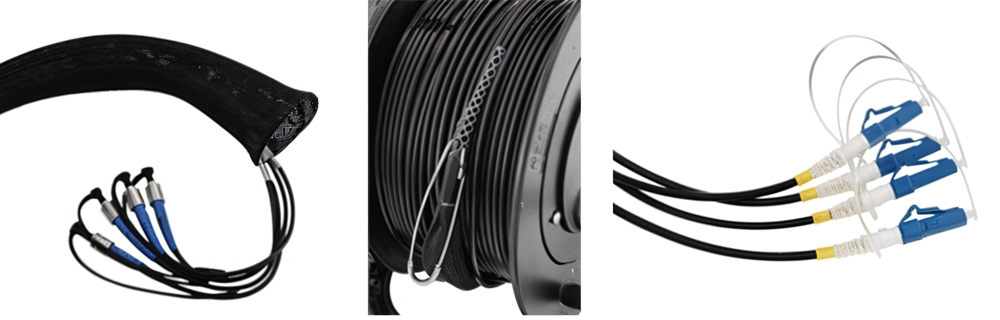
Custom mil-spec fiber cables can be augmented with a wide range of fiber optic connectors to suit various mil-spec applications. The role of the connector is to ensure clear and correct signal transmission by maintaining their alignment even when subject to extreme temperatures or physical stress.
SC (Subscriber Connector)
Features
- Push-pull coupling mechanism
- Spring-loaded ceramic ferrule
Advantages
- Good performance
- Efficient and cost-effective to produce
- Easy to use and maintain
LC (Lucent Connector)
Features
- Push-pull coupling mechanism
- Ceramic ferrule
Advantages
- Small form-factor
ARINC 801
Features
- Specifically designed for aerospace applications
- Compliant with ARINC specifications
Advantages
- Extremely robust
- Vibration resistance
MT (Mechanical Transfer)
Features
- Designed for multi-fiber connections
- Precision plastic or metal guide pins
Advantages
- Space savings
- Weight savings
Fiber Cable Length and Gauge Customization.
When it comes to designing vehicles and facilities for mil-spec applications, weight and space are at a premium. Creating efficiency in both of these areas allows the end user to leverage those savings into additional fuel, equipment, or personnel. Custom mil-spec fiber cable harnesses are one way to realize these weight and space efficiencies and can be manufactured to precise measurements to fit unique vehicle form factors or facility configurations.
In addition, a custom fiber optic cable harness should take into account the impacts of both length and gauge on a fiber optic system’s performance.
Impact of Length on Fiber Optic Performance
The longer the fiber optic cable, the more potential there is for signal degradation. This means that over extended distances, there may be the need to incorporate signal amplification or higher-power transmitters to maintain the integrity of the data transmission.
Longer cables also are more prone to attenuation, the reduction in signal strength as it travels through the cable. Over long distances, the signal weakens, which can lead to lower data transmission rates. To counteract the effects of attenuation over longer lengths, additional signal amplification is often required. This could involve the use of optical amplifiers or repeaters strategically placed along the cable route.
Impact of Gauge on Fiber Optic Performance
Selecting the appropriate gauge is vital for achieving the desired speed, distance, and bandwidth in mil-spec communication systems, ensuring robust and efficient data transmission in the field.
When considering the optimal deployment of fiber optic systems, it’s important to take into consideration that a smaller core diameter, as found in single-mode fibers, allows light to travel in a singular path. This minimizes dispersion, enabling longer transmission distances and higher data transmission speeds. Conversely, a larger core diameter, which is characteristic of multi-mode fibers, permits multiple light paths, which can lead to increased dispersion and limited transmission distances.
Innovation & Future Trends in mil-spec Wiring.
Innovation is at the heart of advancing mil-spec capabilities and staying ahead of bad actors. In the evolving landscape of mil-spec technology, wiring systems are undergoing significant transformations. These changes aim to enhance efficiency, durability, and security in mil-spec operations.
Future trends that could start to impact the design of mil-spec cabling systems deployed at home and abroad include:
Miniaturization and lightweighting
The trend towards miniaturization and lightweighting of wiring components is pivotal for improved mobility and efficiency in mil-spec systems. mil-spec engineers are increasingly focused on reducing the size and weight of wiring systems without compromising performance. This not only enhances the mobility of mil-spec equipment but also contributes to fuel efficiency and operational effectiveness.
Advanced materials
Adoption of advanced materials, such as nanomaterials and composites, is revolutionizing the durability and performance of wiring in challenging environments. These materials offer superior strength, flexibility, and resistance to extreme conditions, making them ideal for mil-spec applications. Nanomaterials in particular provide exceptional electrical conductivity and strength, while composites help enhance resistance to wear and tear, ensuring longer lifespans for mission-critical equipment.
“Smart” cables
The growing integration of Internet of Things (IoT) devices and Artificial Intelligence (AI) will enable smarter and more responsive wiring systems. These technologies can provide real-time diagnostics and predictive maintenance, further enhancing system reliability and efficiency. There are also efforts to enhance the “self-healing” ability of mil-spec systems using technologies that autonomously repair minor damage. This enhanced ability to withstand operational wear and tear means less overall maintenance and a decreased need for manual inspections and repairs, saving time and resources.
Stronger cybersecurity measures
The increased threat of cyberattacks means future wiring systems will likely feature more advanced cybersecurity measures. This includes hardware-based encryption and advanced intrusion detection systems to safeguard sensitive information, as well as innovative tamper-resistance designs to protect critical circuitry.
Increased focus on eco-friendly materials
Sustainability and national security are more closely linked than often realized. Nations can face heightened tensions and even warfare over nonrenewable resources, potentially destabilizing entire regions. Sustainable manufacturing practices are crucial in mitigating the risks of climate change by reducing vulnerabilities to natural disasters, which can weaken infrastructure and compromise mil-spec capabilities. Focusing on the development of sustainable practices fosters economic stability and social well-being, strengthening national resilience.
Integrated wiring systems
Traditional wiring harnesses are increasingly being replace with integrated systems which combine multiple wiring functions into a single, unified network. This evolution aims to streamline installation, reduce weight, and improve overall system efficiency. These advancements can significantly simplify the complexity of mil-spec wiring infrastructure, enable easier and faster deployment of mil-spec systems, further contribute to force mobility and fuel efficiency, and reduces potential points of failure.

Partnering with a Trusted Mil-Spec Fiber Optic Cable Solutions Provider.
When you choose the manufacturer for your mil-spec fiber cable assemblies, you need a provider who understands the unique demands of the mil-spec sector.
Why Choose Major Custom Cable
Major Custom Cable has been at the forefront of data and communications cabling since 1990. We have the deep expertise and manufacturing capabilities to meet and defeat the challenges posed by the extreme conditions and security demands of mil-spec system applications.
When you partner with Major Custom Cable, you can count on:
Quality and Performance
Our mil-spec service members deserve nothing less than the highest quality and reliability in the equipment they use. Whether it’s weaponry, communication systems, or vehicles, the failure of a single piece of the puzzle can have catastrophic consequences. We can design, test, and produce components that not only meet but exceed these rigorous standards. This assurance of quality and reliability builds trust and ensures the effectiveness of mil-spec operations.
Compliance
The mil-spec sector operates under a labyrinth of strict regulations and compliance standards. These guidelines are put in place to ensure the highest levels of safety, reliability, and effectiveness. Our deep understanding of these regulatory frameworks can ensure that all products meet or exceed these stringent requirements. This not only mitigates the risk of costly fines and penalties but also guarantees a smoother procurement process.
Security
mil-spec projects often involve highly sensitive information and cutting-edge technologies. Protecting this information from unauthorized access or theft is paramount. We have robust security measures and protocols in place to safeguard these assets. This ensures that confidential information remains secure, thereby maintaining the integrity of mil-spec operations.
Innovation
We are continually evolving, driven by emerging threats and technological advancements. This makes us better positioned to innovate and adapt to these changes. By integrating the latest technologies into our products, we ensure they remain cutting-edge and effective. This adaptability is crucial for maintaining a competitive edge and addressing future challenges.
Browse Mil-Spec Fiber Optic Cable Solutions from Major Custom Cable.
Major Custom Cable offers a number of high performance mil-spec fiber optic connectors.
M28876
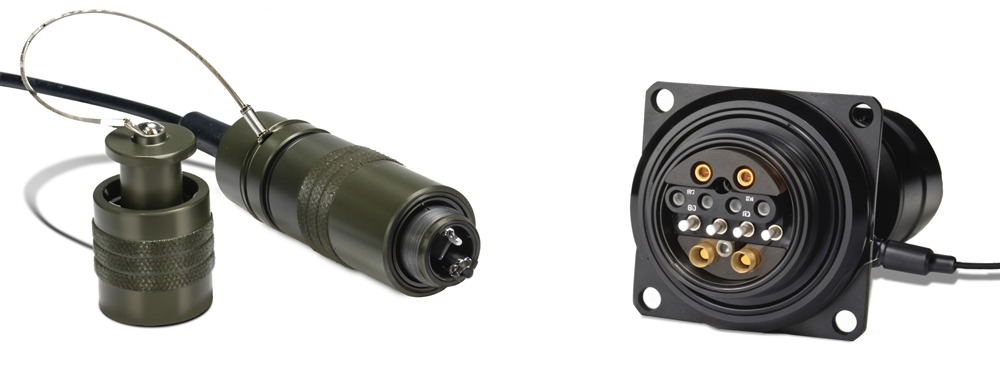
A universal standard for the U.S. Navy, MIL-PRF-28876 interconnects have become a critical part of shipboard and ship-to-shore data transmission systems, as well as combat communications systems. These components are designed for ship, surface, submarine, and mobile shelter applications
MIL-DTL-83526
This specification applies to rugged, circular fiber-optic connectors with a hermaphroditic interface. These assemblies are ideal when a system must be rapidly deployed in the field and are often used in radar and SATCOM installations. They can also be found in marine, aerospace, transportation, and commercial entertainment communications networks
Multi-fiber Tactical Trunk Cables
Ideal for outdoor Aerospace data applications that require equipment retrieval for reuse, Major Custom Cable’s polyurethane tactical multi-fiber trunk cables strike an optimal balance between durability and lightweight portability.
PIERSIDE
As its name suggests, the Pierside fiber optic connector is optimized for performance in demanding shore, pierside, or shipboard environments. Designed for efficient reconfiguration and field maintenance, this class of component is utilized by multiple branches of the U.S. mil-spec and companies in the oil, gas, and geoscience industries.
TFOCA-II®
Rugged and reliable, this hermaphroditic connector series has become a standardized part of the U.S. Army’s tactical deployable networks. It is also ideal for use in broadcast and mobile networks, including satellite ground stations, and commercial operations in extreme environments, like mining.
Major Custom Cable: Powered by American Ingenuity .
Based in Missouri, Major Custom Cable has been producing high performance cabling solutions for some of the largest distributors and OEMs in the world since 1990. All of our components are manufactured to the most rigorous standards at our 50,000 square-foot, ISO 9001-registered facility.
From simple part production to the most complex custom mil-spec assemblies, every solution is tested and backed by our team of experts and a one-year warranty.
Ready to build your custom cable solution? Get in touch to get started.