
Small form factor (SFF) vs Very Small Form Factor (VSFF)
Born out of telecommunications, fiber optic cables and connectors now provide high-speed data transmission and reliable connectivity in a wide variety of contexts, such as broadcast, live performances, military applications, and medical equipment.
As network infrastructure everywhere continues to expand, so does the need for compact, efficient, and high-performance solutions. Among these, Small Form Factor (SFF) and Very Small Form Factor (VSFF) connectors have emerged as essential components in advanced systems.
This post explores the unique characteristics of SFF and VSFF fiber optic connectors. By comparing these two categories, we’ll get some deeper insight into their advantages, challenges, and the factors to consider when selecting the optimal solution for specific design requirements.

What Are SFF and VSFF Connectors?
Among the recent innovations in fiber optic connectivity are Small Form Factor (SFF) and Very Small Form Factor (VSFF) connectors, both designed to maximize performance while minimizing size.
Small Form Factor (SFF) Connectors
SFF connectors are designed to provide high-density connectivity in a compact footprint. Common examples include LC (Lucent Connector) and MU (Miniature Unit) connectors, both of which are approximately half the size of standard SC (Subscriber Connector) connectors. This smaller size makes SFF connectors ideal for applications where space is at a premium.
Very Small Form Factor (VSFF) Connectors
VSFF connectors take miniaturization a step further. With an even smaller footprint than SFF connectors, these are designed to meet the growing demand for high-density connections in increasingly compact devices. Examples include the CS, SN, and MDC connectors, which are gaining popularity in cutting-edge applications like 5G infrastructure, military-grade communication systems, and lightweight wearable medical devices.
Legacy Connectors: LC and LC Uniboot
As fiber optic technology has advanced, LC connectors have remained a steadfast standard to their compact size, reliability, and ease of use. With the growing demand for high-density solutions, innovations such as the LC Uniboot connector have emerged to address space and cable management challenges.
LC Connectors: A Proven Standard
The LC (Lucent Connector) has long been a cornerstone of fiber optic connectivity. Designed as a Small Form Factor (SFF) connector, the LC’s compact design — half the size of the older SC connector — makes it well-suited for applications where space is limited. Its push-pull locking mechanism ensures secure connections, while its performance in high-speed data transmission has solidified its role in telecommunications, broadcasting, and data center environments.
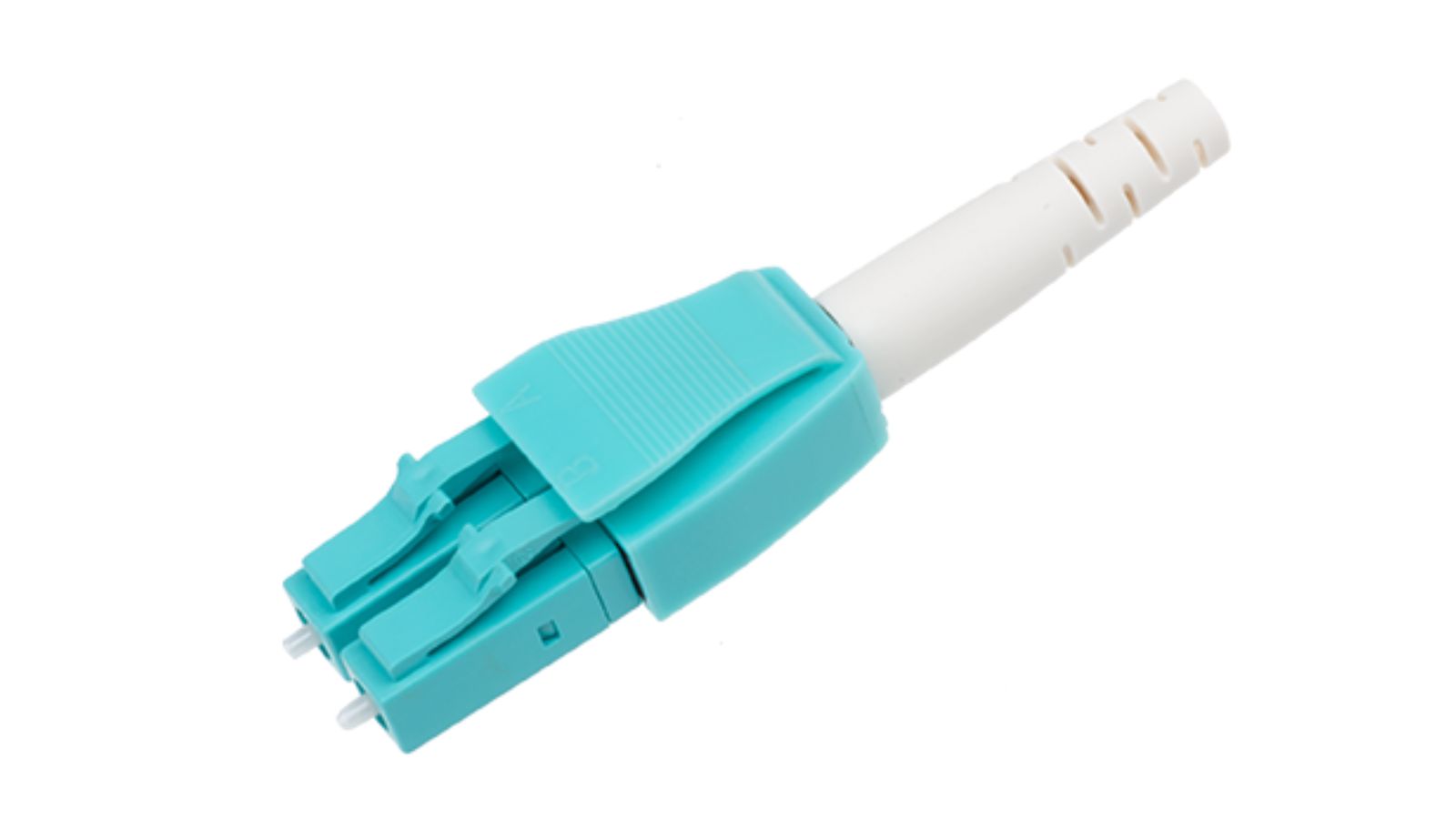
LC Uniboot Connectors: Simplifying Cable Management
Building on the success of the LC connector, the LC Uniboot is designed to optimize space utilization even further, while streamlining cable organization. Unlike traditional LC duplex connectors that require two cables for transmitting and receiving signals, the Uniboot consolidates both into a single cable. This design significantly reduces clutter and improves airflow in densely populated panels and racks.
The benefits of LC Uniboot connectors go beyond compact size. Their reversible polarity feature allows for easier installation and maintenance, making them ideal for environments where rapid deployment and reconfiguration are critical for operations.
New Market Entrants: SN, CS, and MDC Connectors
As the demand for ultra-compact, high-performance fiber optic solutions grows, a new wave of connectors has entered the market, redefining what is possible in terms of size, density, and efficiency. SN, CS, and MDC connectors represent the cutting edge of fiber optic technology, offering innovative solutions for space-constrained and high-density environments.
SN Connectors: Versatility in Compact Design
Developed to support next-generation networks, SN connectors are designed for duplex fiber connections in high-density applications. Featuring a push-pull mechanism similar to the LC connector, the SN offers a smaller footprint by splitting what would traditionally be a duplex LC into two individual connectors. This separation provides increased flexibility in patch cord management while enabling easier maintenance and scalability.
CS Connectors: Compact Efficiency for High-Density Needs
The CS connector is another compact solution designed to address the ever-tightening space constraints in complex networks. Its ultra-small size allows it to double the density of traditional LC connectors in a single patch panel. CS connectors feature a dual-fiber design that simplifies cable management without sacrificing performance
MDC Connectors: Ultra-Compact Innovation
At the forefront of miniaturization is the MDC connector, which offers the smallest footprint among VSFF connectors. These ultra-compact connectors maximize density by fitting three fibers into the space typically occupied by one LC connector. MDC connectors are pushing the boundaries of what is possible in space-constrained environments.
Comparative Analysis: SFF vs. VSFF Connectors
Below, we compare Small Form Factor (SFF) and Very Small Form Factor (VSFF) connectors across three key dimensions: size, performance, and suitability for high-density applications.
Size and Ease of Handling
SFF connectors, such as LC and SC types, are well-established in the industry and offer a compact footprint. However, VSFF connectors like SN, CS, and MDC redefine compactness, significantly reducing space requirements. The smaller size of VSFF connectors makes them ideal for modern, high-density racks, but handling them may require more precision, which can pose challenges during installation or maintenance.
Performance Metrics: Insertion Loss and Return Loss
Both SFF and VSFF connectors deliver excellent optical performance, but VSFF connectors often edge ahead in minimizing insertion loss and optimizing return loss. These performance metrics are critical in high-bandwidth applications, where maintaining signal integrity is paramount. VSFF connectors are engineered to handle next-gen data speeds, making them a forward-looking choice for organizations prioritizing scalability.
Suitability for High-Density Applications
Data centers and telecom networks demand solutions that maximize port density without compromising performance. While SFF connectors are a proven choice for many installations, VSFF connectors allow for even greater port density due to their reduced size. This advantage can lead to significant space and cost savings.

Finding the Right Cables and Connectors for Your Project
As industries adopt smaller connectors like SN, CS, and MDC, the benefits become clear: enhanced performance, reduced insertion loss, and unparalleled space efficiency. These innovations enable organizations to future-proof their infrastructures, supporting ever-growing data rates and density requirements. The evolution of connector technology is far from over, with ongoing advancements poised to unlock even greater possibilities in connectivity.
At Major Custom Cable, we understand the importance of selecting the right connector for your unique application. Our commitment to delivering custom solutions ensures your business stays ahead of the curve in this ever-changing landscape.
Have questions about which connector is right for your needs? Our team at Major Custom Cable is here to help. Whether you’re designing a new system or upgrading an existing network, we can guide you to the best solutions tailored to your requirements.
Explore our product offerings or contact us directly to speak with an expert to learn more about our fiber optic connectivity solutions.